Publications
Letter From the CIO - August 2026
Good Companies, Good Investments?
- The macroeconomic environment remains favourable, but the level of risk compensation now calls for greater discipline.
- AI remains a strong conviction, but should be approached selectively, through infrastructure and geographic and sector diversification.
- A good company is not automatically a good investment: valuation and risk management remain key factors.
Why price and risk compensation matter again
Over the summer, the macroeconomic backdrop has remained broadly supportive, with recent U.S. data pointing to a resilient, albeit gradually moderating, economic cycle. ISM Manufacturing and Services PMIs remain firmly anchored in expansion territory, while headline and core CPI eased to 3.4% and 2.5%, respectively, in July, from 3.5% and 2.6% in June. The labour market has softened more noticeably, with nonfarm payrolls declining by 23,000 in July. However, unemployment remains low at 4.1%, pointing to an orderly cooling rather than a sharp deterioration in labour-market conditions. Monetary policy remains restrictive but stable. The Federal Reserve maintained its target range at 3.50–3.75% in July, with the effective Fed Funds rate around 3.63%. The combination of resilient activity, a cooling labour market and moderating inflation could limit the need for the Fed to tighten from current levels. Overall, the macro backdrop remains constructive for risk assets.
But supportive does not necessarily mean attractive at any price. Valuations remain demanding in parts of the equity market, credit spreads are compressed, while government bonds once again offer meaningful nominal and, importantly, real yields. Investors therefore face a different question from the one that dominated the zero-rate era: how much incremental return are we being offered for each additional unit of risk?
AI: strong fundamentals, demanding expectations
Technology (artificial intelligence in particular) provides perhaps the clearest illustration. Our long-term conviction in AI remains unchanged. What started as a semiconductor and software story has evolved into a much broader investment cycle spanning data centres, power generation, transmission networks and infrastructure, with the largest hyperscalers expected to deploy hundreds of billions of dollars in CapEx in 2026 alone. However, if the fundamental story remains powerful, the price investors are being asked to pay for that growth has become increasingly demanding. At a 25x forward P/E, the corresponding earnings yield is only 4.0%, falling to 3.3% at 30x. At these valuation levels, more of today's value depends on earnings expected further into the future, leaving less room for disappointment. At the same time, dispersion within technology is increasing. The average three-month pairwise correlation between the Magnificent Seven has fallen to approximately 0.27, from a peak of around 0.78 in 2025. The “Big Tech” trade is therefore increasingly giving way to individual investment cases, where earnings delivery, margins, capital allocation and free-cash-flow generation matter more.
The other side of AI: capital intensity
Until recently, equity markets focused primarily on the growth AI investment could generate. Increasingly, investors are asking another question: what return will companies ultimately generate on the enormous amount of capital being deployed?
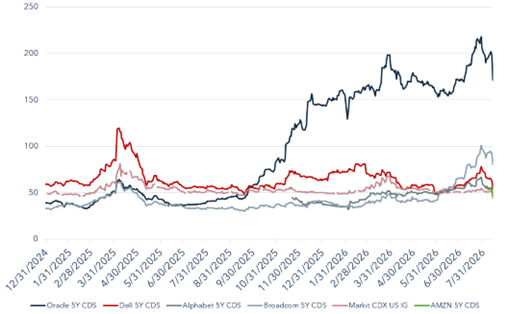
The focus is shifting from revenue growth towards free-cash-flow conversion, incremental ROIC and the spread between ROIC and WACC. An investment creates economic value only when the return on incremental capital exceeds its cost. As CapEx grows faster than internally generated cash flow for some companies, financing requirements are also extending into public debt and private-credit markets. Credit markets have started to notice. Oracle provides one of the clearest examples: its five-year CDS has recently traded around 200 bps, materially above levels typically associated with the largest investment-grade technology companies. This is not a signal of imminent default, but it does show that markets are increasingly putting a price on the balance-sheet consequences of the AI investment cycle. Equity investors are asking how much growth AI will generate. Credit investors are increasingly asking how that growth will be financed.
5-Year CDS Spreads of U.S. Tech Companies (bps)
Source: Bloomberg / Banque Heritage
The hurdle rate is higher (%)
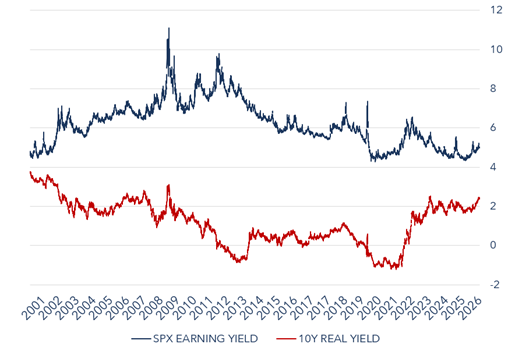
The alternative to equities no longer yields nothing. U.S. inflation-protected government bonds currently offer real yields above 2%, a fundamental shift from the post-GFC era of zero or negative real rates. Investors can once again earn a meaningful return above inflation without assuming corporate credit or equity risk, effectively raising the hurdle rate for risk assets. Let’s consider again a company trading at 30x forward earnings, equivalent to an earnings yield of just 3.3%. Against a real risk-free yield above 2%, the starting premium is relatively narrow before accounting for equity volatility, earnings uncertainty and valuation risk. While equities offer participation in future earnings growth, the implication is clear: growth now has to work harder to justify valuation. And this is particularly relevant for long-duration technology stocks!
U.S. Equity Market Risk Premium
Source: Bloomberg / Banque Heritage
And Credit tells a similar story. Healthy corporate fundamentals have compressed spreads, leaving investors with relatively limited additional compensation for taking credit risk. At these levels, the payoff becomes increasingly asymmetric: modest additional carry if conditions remain benign, but greater downside should growth, liquidity or risk sentiment deteriorate. This is not a credit-crisis signal; it is a price-of-risk signal.
Risk is not the enemy. Mispriced risk is.
This brings us back to portfolio construction. We believe AI should remain a core investment theme, but one that should increasingly be approached through a broader set of exposures, including AI infrastructure and power demand, as well as selected Emerging Markets, particularly in Asia, which play a critical role in semiconductor and technology supply chains. However, after several years of U.S. technology leadership and increasingly demanding valuations, we also favour a gradual rotation towards more value-oriented sectors and themes to broaden return drivers and achieve a better balance of risk.
In fixed income, positive real yields have materially improved the relative attractiveness of developed-market government bonds, which we favour over Investment Grade credit, where compressed spreads offer limited additional compensation for credit risk. We also maintain exposure to convertible bonds and selected Emerging Market debt, while uncorrelated strategies such as catastrophe bonds remain valuable sources of portfolio diversification.
This does not make us bearish. The economic cycle remains resilient and recession risks contained. We therefore believe investors should stay invested. But a constructive macro view does not remove the need for valuation discipline and a more balanced allocation of risk.
AI may prove to be one of the defining technological transformations of our generation, but not every company will emerge as a winner. A great business is not necessarily a great investment at any price. As Warren Buffett put it: “It’s far better to buy a wonderful company at a fair price than a fair company at a wonderful price.” Ultimately, a good company is defined by the quality of its business, while a good investment is defined by the relationship between its fundamentals, its valuation and the risk required to own it.
August 18, 2026
Publications
Publications
BANQUE HERITAGE POSTS SOLID HALF-YEAR RESULTS IN ITS 40TH ANNIVERSARY YEARGeneva, 29 July 2026 – Banque Heritage announces strong half-year results, confirming the Bank's sustained growth trajectory.
July 29, 2026
Publications
OUTLOOK 2026 H2For more than a decade, investors operated in a world shaped by central banks: low inflation, abundant liquidity and ever-lower interest rates.
June 23, 2026